Dr. Gymbro
←

#high-intensity exercise

1 article
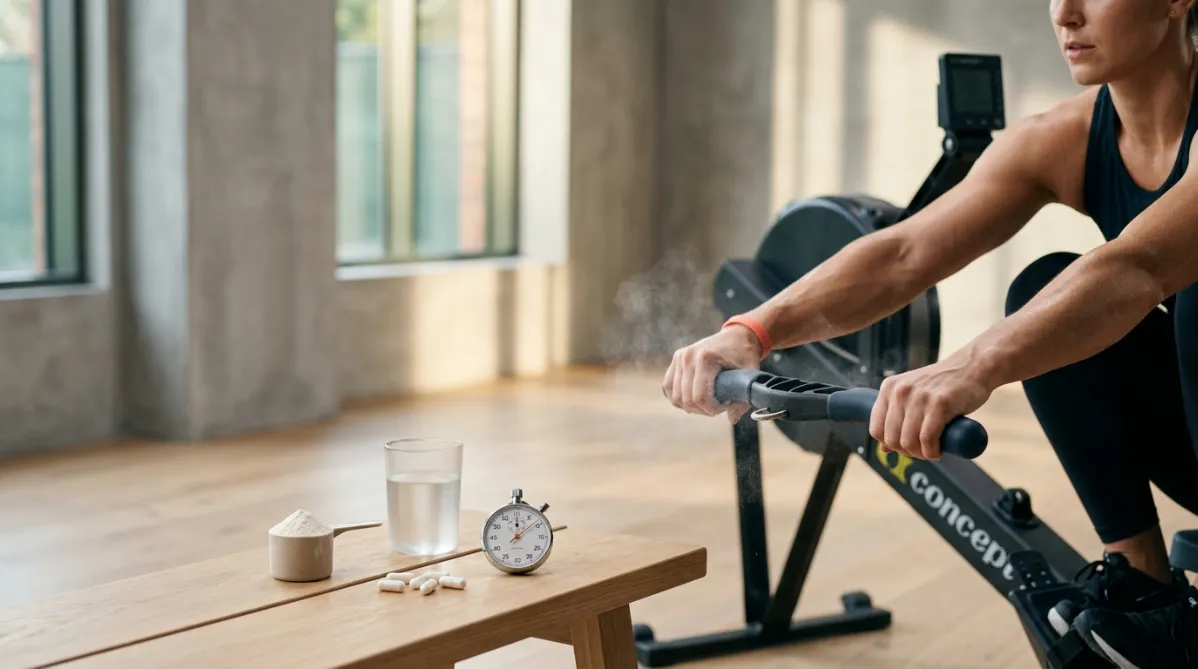
A wide, minimalist editorial scene of an athlete's hands and forearms gripping the handles of a rowing ergometer, shot in soft natural light from a large window in a clean, airy training studio. The athlete is mid-pull, forearm muscles subtly defined, a light sheen of sweat on the skin, chalk dust floating in the air. In the foreground on a pale oak bench sits a small ceramic scoop of fine white powder beside a matte glass of water, with a few loose white capsules arranged neatly in a gentle curve. A minimalist analog stopwatch with a clean white face lies next to them, its hand paused near the two-minute mark.

The color palette is calm and modern: warm off-white, soft sand, muted sage green, and a single accent of coral orange in the stopwatch hand and the rower's wristband. The background is softly blurred concrete and pale wood with long, gentle shadows stretching across the floor. Shallow depth of field keeps the hands, powder, and stopwatch crisp while the rest dissolves into creamy bokeh.

Composition follows the rule of thirds: the rowing handles and hands occupy the right third, the bench still life sits in the lower left, and open negative space in the upper left leaves room for a title overlay. The mood is focused, quiet, and intentional, like a high-end health and science journal feature. Fine film grain, subtle matte finish, editorial photography style, natural color grading, and no text or logos.
general

Beta‑alanina funciona? Uma meta‑análise diz que sim para esforços de 60–240 segundos

BY DR. GYMBRO ·

A beta‑alanina tem sido divulgada como forma de reduzir a fadiga muscular em exercícios intensos, mas será que realmente funciona? Uma meta‑análise com 15 estudos e 360 participantes mostrou um benefício real, embora modesto, com um ganho mediano de 2,85 %. O efeito foi mais evidente em esforços entre 60 e 240 segundos, menor em atividades acima de quatro minutos e inexistente em sprints de menos de um minuto. O artigo também aborda a estratégia de carregamento mais comum – de 3,2 a 6,4 g por dia durante quatro ou mais semanas –, como dividir as doses pode diminuir o formigamento e quais atletas têm mais a ganhar.

This page is available in